
SteelX Rebar
Products

Two products. One decision.

Both are twisted steel reinforcement, both mix straight into the truck. The 5:25 works before the concrete cracks; the 8:45 works after it does. Most projects use one — some use both.
1800 MPa
minimum tensile strength, both products
2–5×
pullout resistance vs traditional steel fibre
7–40 kg/m³
dosage range across delivered projects
0 kg
steel to cut, tie, chair or crane
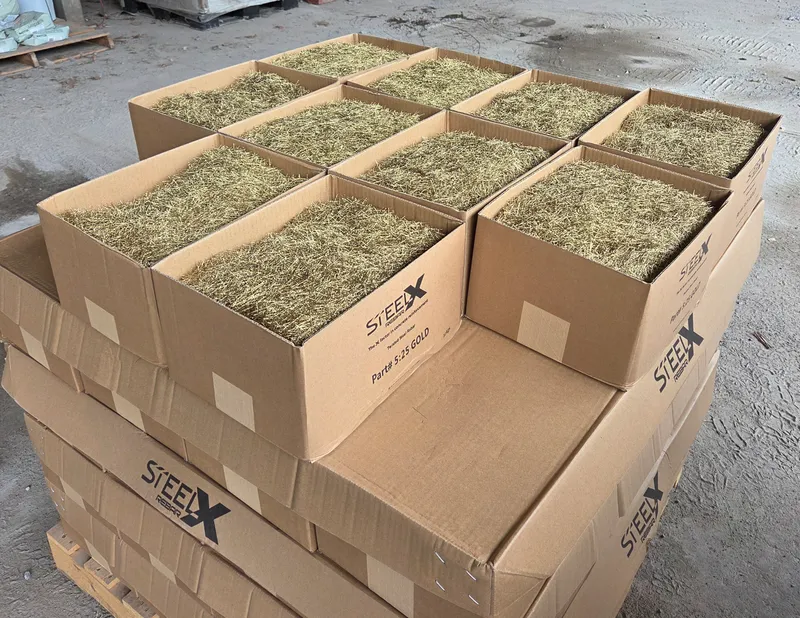
Boxed SteelX 5:25 twisted steel rebar on a pallet
SteelX 5:25 Gold

The workhorse. Brass coated twisted steel rebar that mixes straight into fresh concrete, bonding over its full length. Works proactively — it lifts the concrete’s own properties before a crack ever forms.
Specification
Length 25 mm
Diameter 0.50 mm
Aspect ratio 50
Strands 25,300 per kg
Tensile strength 1800 MPa min
Coating Brass, corrosion resistant
Typical dosage 7–50 kg/m³
Design target Pre-crack + modulus of rupture
Where it goes
Slabs on ground Liberty™ Slab Footings Bored piers Pavements House slabs Shotcrete
What it does
◆Twisted shape creates torsional anchorage — pullout means untwisting, not sliding
◆2–5× stronger pullout than traditional steel fibres
◆Proactive reinforcement before visible cracks form
◆Brass coating for wash-down, bunded and exposed environments
◆Mixed directly into fresh concrete — no manual placement
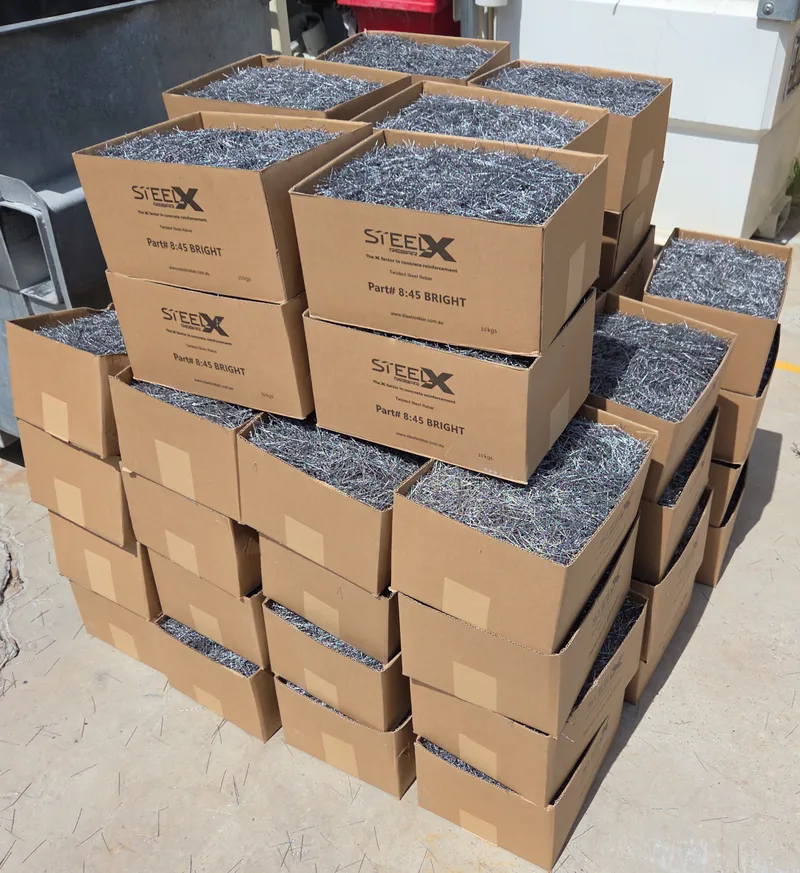
Boxed SteelX 8:45 twisted steel rebar on a pallet
SteelX 8:45 Structural

The heavy-duty profile. Longer and thicker, for structural and high-load work where the design case is what happens after the concrete cracks. Delivers stable post-crack capacity you can design against.

Specification
Length 45 mm
Diameter 0.80 mm
Aspect ratio 56
Strands 5,400 per kg
Tensile strength 1800 MPa min
Coating Uncoated
Typical dosage 7–50 kg/m³
Design target Post-crack residual capacity
Where it goes
Structural elements Heavy-duty pavements Bored piers Strip footings Walls Mining
What it does
◆Mechanical interlock with the concrete matrix along the full strand
◆Enhanced tensile splitting strength for structural design
◆Stable residual capacity after first crack
◆Reinforces at watertight crack widths, under 0.10 mm
◆Larger profile suits higher dosages and thicker sections

Which one do I specify?

The short version: if you’re removing mesh from a slab, it’s the 5:25. If you’re replacing bar in a structural element, it’s the 8:45.

Consideration
SteelX 5:25
SteelX 8:45
The design case
Before the crack — lifts the concrete's own flexural capacity.
After the crack — residual capacity you design against.
What it replaces
Mesh, and slab thickness.
Bar and cages in structural elements.
Typical dosage
7–50 kg/m³
7–50 kg/m³
Strands per kg
25,300 — far more, finer distribution.
5,400 — fewer, heavier strands.
Corrosion exposure
Brass coated. Use for wash-down, bunded and exposed slabs.
Uncoated. Use where cover and exposure are conventional.
Liberty™ Slab
Yes — the system is built on it at 18 kg/m³.
No — the Liberty system specifies the 5:25.
Finishing
Finishes conventionally. Broom, trowel or polish.
Heavier profile; discuss finish requirements early.

Dosage by application

Indicative rates drawn from delivered projects. Final dosage always comes from a project-specific design — send us the drawings and we’ll do it.

Application
Product
Dosage
Paired with
Liberty™ jointless slab
5:25
18 kg/m³
SL72–SL102 mesh, E5 Internal Cure
Mesh-free slab on ground
5:25
8–15 kg/m³
Nothing — mesh removed outright
Mesh-free industrial slab
8:45
14 kg/m³
House slab, flat plate
5:25
14–18 kg/m³
SL82–SL92 mesh
Strip footings, pad footings
5:25
10–20 kg/m³
Steel at peak stress only
Bored piers
5:25
15–20 kg/m³
1N20–1N24 central bar
Heavy industrial pavement
5:25
12–18 kg/m³
SL92 mesh, one or two layers
Structural watertight
5:25 / 8:45
15–40 kg/m³
Conventional reinforcement retained
Documentation

Technical downloads

Everything you need to specify, batch and place SteelX. Download the data sheets and batching method, or request any other document and we’ll send the current revision the same day.

Request the full pack →
Method PDF · Download
SteelX batching method & register
The approved batch plant procedure, with the batch register for recording every truck.
Download PDF →
TDS PDF · Download
SteelX 5:25 technical data sheet
Physical properties, applications, mixing procedure and typical dosages.
Download PDF →
TDS PDF · Download
SteelX 8:45 technical data sheet
Physical properties, applications, mixing procedure and typical dosages.
Download PDF →
SDS PDF
Safety data sheet
Handling, storage, PPE and site safety information for both products.
Request document →
Design PDF
Liberty™ Slab design guide
Jointless slab design method, thickness tables, mesh pairing and joint detailing.
Request document →
Spec DOCX
Specification clauses
Drop-in specification text for slabs, footings and watertight elements, to CCAA T48.
Request document →
CAD DWG
Standard construction details
Construction joint, dowel, re-entrant corner and edge detailing for jointless slabs.
Request document →

Safety data sheets, design guides and specification clauses are issued on request so you always receive the current revision. Specifications are subject to change — confirm against the issued document before it goes on drawings.

Dosing & QA

We dose it on site. You get the record.

Blown in at the truck
McClay doses SteelX into each truck on site with a fibre blower, at the specified kg/m³, in front of your crew.
Matched to each load
The dose is set by each truck's volume, not by counting bags.
Any supplier
The batch plant doesn't need to stock or handle SteelX — use whichever supplier suits the job.
Every truck on record
Docket photo, load volume, dose rate, time, GPS and operator sign-off, logged in QA McClay.
See the dosing & QA service →

Get a free analysis on your project

Send us your drawings and we’ll show you what comes out: the mesh, the rebar, the thickness, the weeks.